


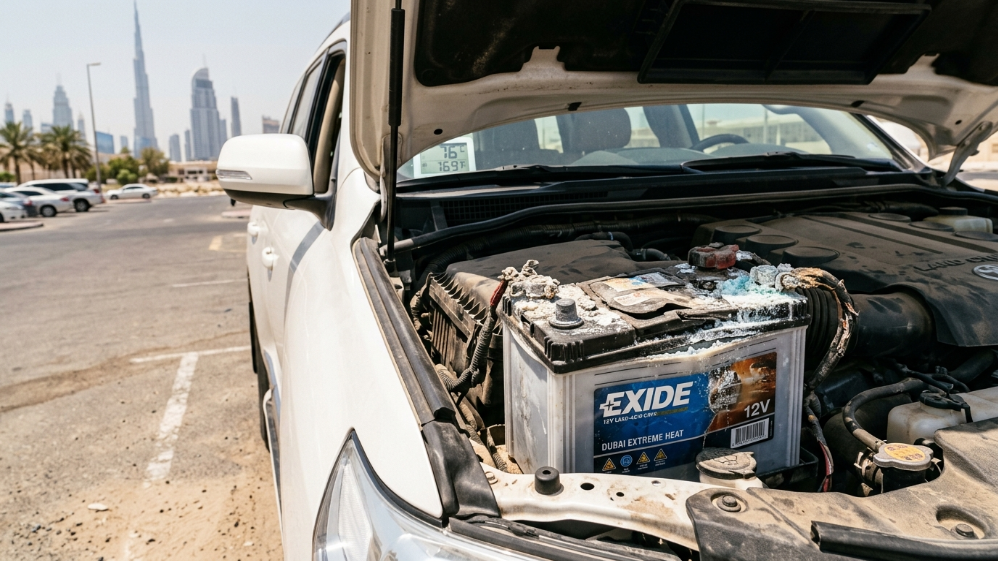
How Extreme Cabin Temperatures Destroy Car Battery Components in Dubai?
UAE summers are brutal. Between June and September, temperatures go above 45°C. A parked car in direct sunlight hits 80°C inside the cabin within 20 minutes. That heat quietly destroys your car battery, one component at a time.
Most drivers do not notice the damage until the battery stops starting the engine. At Sayara Battery, our team diagnoses hundreds of heat-damaged batteries every year and provides professional car battery replacement in Dubai.
This guide explains which 6 battery components are damaged by extreme cabin temperatures, how the damage happens, and the 7 steps every driver should take before peak summer.
Why Cabin Temperature in Dubai Feels More Intense Than Ambient Air Temperature?
Most people focus on outdoor air temperature as the main problem for car batteries in the UAE. It is not the full picture.
The battery lives inside the engine bay. On a 45°C afternoon, under-bonnet temperatures reach 70 to 80°C. In busy spots like Al Quoz or Sharjah border traffic, they can exceed 85°C. The internal electrolyte temperature of a lead-acid battery crosses 50°C at those levels, the point where harmful chemical reactions speed up fast.
Winters also play a role. Nights in December and January drop to 10 to 14°C. A battery weakened by summer heat then has to push out 40 to 60% more cranking current on cold mornings. That 60°C+ swing between a July engine bay and a January morning start stresses a car battery more than almost anywhere else in the world.
The 6 Critical Battery Components That Extreme Heat Damages
1. The Electrolyte Solution: Accelerated Evaporation and Stratification
The electrolyte inside a lead-acid battery is a mix of sulfuric acid and distilled water. Above 50°C, water evaporates at 3 to 5 times the normal rate. When the level drops, the top of the lead plates is exposed to air. Those plates sulfate. Sulfation means a hard, non-conductive lead sulfate crust forms on the plate surface and permanently reduces charge-holding capacity.
A 2023 study by Prasad et al. in Battery Energy (Wiley) confirmed that high operating temperatures speed up grid corrosion, active material shedding, and electrolyte loss in lead-acid batteries.
In the UAE, an unmaintained battery loses electrolyte health in 12 to 18 months versus 36 to 48 months in cooler climates. Heat also causes electrolyte stratification, where heavier sulfuric acid sinks to the cell bottom, and water rises to the top, creating uneven corrosion across the plates.
2. Lead Plates: Corrosion, Warping, and Active Mass Shedding
Extreme heat attacks lead plates in 3 ways:
- Positive grid corrosion. Heat speeds up oxidation on the lead-antimony positive grid. Over time, this weakens the plate and reduces conductivity.
- Active mass shedding. The lead dioxide material loosens under repeated heating and cooling. It falls off and collects as sediment at the case bottom. When sediment touches the plate edges, it causes internal short circuits. The battery fails without warning.
- Plate warping. Above 60°C, the lead plates bend out of shape. Warped plates raise internal resistance, create more heat during charging, and keep worsening until the battery fails.
The Arrhenius principle states that the corrosion rate doubles for every 10°C rise in temperature. A battery running at 45°C instead of 25°C loses roughly 50% of its total service life.
3. The Separator: Compression Failure and Internal Short Circuits
Separators are thin porous polyethylene sheets between the positive and negative plates. They keep the plates apart while letting ionic current pass through the electrolyte.
In extreme heat, separators shrink and become stiff. When warped plates press against them, micro-tears form. Through these tears, the plates make direct contact and create an internal short circuit. The battery then drains itself even when the car is off. This is why a car parked for 3 to 4 days can return with a completely flat battery and no obvious reason.
4. The Battery Casing: Thermal Expansion and Acid Leaks
Charging produces hydrogen and oxygen gas inside every battery. Under normal conditions, it exists through small vents.
When internal temperature exceeds 55°C, gas builds up faster than the vents can handle. The polypropylene casing bulges outward. This is called battery bloating. It is not cosmetic. A bloated casing means electrolyte has moved away from the plates, internal pressure has distorted plate geometry, and sulfuric acid may soon leak into the engine bay.
Check the casing every 3 months. If any side looks bowed or convex, get it tested professionally right away.
5. The Battery Terminals: Accelerated Corrosion and Resistance Buildup
Heat speeds up the reaction between lead terminal posts and copper battery clamps. A white, blue, or greenish powder of lead sulfate and copper sulfate forms around the connections. Both are poor conductors.
Even 1mm of this corrosion reduces cranking power by 15 to 25%. A battery at 100% health on a test may deliver only 75 to 85% of its rated cold cranking amps in practice. Fine desert silica dust traps moisture on the terminals and keeps corrosion active even outside peak summer.
6. The Battery Management System in AGM and Modern Vehicles
Many modern vehicles use AGM (Absorbent Glass Mat) batteries. These include hybrids like the Toyota Camry Hybrid and premium models from Mercedes-Benz, BMW, and Audi. These cars also have a Battery Management System, or BMS, that tracks cell voltage, temperature, and charge level.
Repeated exposure to engine bay temperatures above 70°C causes BMS calibration to drift. A mis-calibrated BMS lets the alternator overcharge the battery using cool-weather rates. It also reports the wrong charge level, showing 70% when the battery is actually at 40%. The driver gets no warning until the car will not start.
The Unique Dubai Factor: The Cold-to-Hot Thermal Shock Cycle
Most battery advice misses a damage pattern specific to this region. It is called the thermal shock cycle.
A car parked overnight in a covered basement in JBR, Business Bay, or Downtown cools to about 18 to 22°C. The next morning, the driver enters direct sunlight. Within 30 minutes on roads like Al Wasl or Sheikh Mohammed Bin Zayed Road, the engine bay hits 65°C.
That is a 40 to 50°C jump in under one hour. Every material inside the battery expands and contracts with each cycle. Over 150 to 200 such cycles per year, this physical fatigue breaks down lead plates, separators, and the polypropylene casing. Most standard batteries fail in under 2 years under these conditions.
7 Steps to Protect Your Car Battery From Extreme Cabin Temperatures in Dubai
- Park in covered or shaded locations whenever possible. Covered car parks keep engine bay temperatures 25 to 30°C cooler than open lots and extend battery life by 40 to 60%.
- Schedule a battery health check every 6 months. A conductance-based load test measures cold cranking amps, internal resistance, and state of charge under real load. Book in March and again in September.
- Clean battery terminals every 3 months. Apply terminal protection spray after cleaning to block moisture, especially during the humid October to April period.
- Upgrade to an AGM battery if your car supports it. AGM batteries hold electrolyte in glass mat separators instead of free liquid. This makes them 3 to 4 times more resistant to evaporation damage in high heat.
- Avoid making only short trips under 5 kilometers. The alternator needs 15 to 20 minutes of driving to restore what a cold start uses. Drivers doing short daily commutes in Al Barsha, Deira, or Karama should use a smart battery maintainer overnight.
- Replace batteries older than 2 years proactively. A battery with no symptoms at 24 months can fail within 3 to 6 months in this climate. A replacement from Sayara Battery costs AED 350 to 600, far less than a recovery call.
- Check for parasitic electrical drain. Modern cars with multiple ECUs, dashcams, and GPS units draw power when parked. A drain above 50 milliamps keeps the battery in partial discharge. Combined with heat, this shortens battery life significantly.
The Seasonal Battery Risk Calendar for Dubai Drivers
- January to February: Nights drop to 10 to 20°C, increasing cold cranking demand. Test any battery older than 18 months before the cold season ends.
- March to April: Heat rises. Evaporation and plate corrosion accelerate. This is the most important window for a pre-summer battery inspection.
- May to September: Peak heat season. Engine bay temperatures regularly exceed 70°C. Check terminals and casing shape every month.
- October to December: Heat drops, but humidity rises. High moisture accelerates terminal corrosion. Clean and protect terminals during this window.
The 5 Most Critical Warning Signs of Heat-Damaged Car Battery Components in Dubai
Test or replace your battery immediately if you notice any of these 5 warning signs:
- Slow engine crank on first morning start: points to plate sulfation or electrolyte loss, cutting cold cranking amps
- Swollen or distorted battery casing: means dangerous internal gas pressure has built up
- White or blue crystalline powder on the terminal posts: resistive corrosion cutting available power by 15 to 25%
- Battery warning light staying on after engine start: the battery or alternator is struggling to hold a charge under AC load.
- Needing a jump-start more than once in 6 months: the battery can no longer hold a working charge and needs immediate replacement
Why Sayara Battery Is the Trusted Choice for Car Battery Replacement in Dubai?
Sayara Battery focuses on one thing: car battery diagnostics, supply, and replacement across the UAE. Every battery we supply is rated for high-temperature operation and selected for local heat conditions, not sourced from European stock built for cooler climates.
Our services include a free battery health check using conductance-based load testers, same-day replacement with mobile service across Deira, Bur Dubai, Jumeirah, Al Quoz, Business Bay, and Downtown areas, a full range of conventional, AGM, and EFB batteries for all vehicles, and environmentally responsible disposal under UAE regulations.
If your vehicle is over 18 months old and has not had a battery check, book a load test with Sayara Battery today. Heat damage builds without visible signs. Do not let a dead battery be the first warning.